Follow the Lines: A Simple Way Into Composition
Edges, repeated directions and implied connections can guide a viewer through a painting. Try tracing a visual route before reading an interpretation.
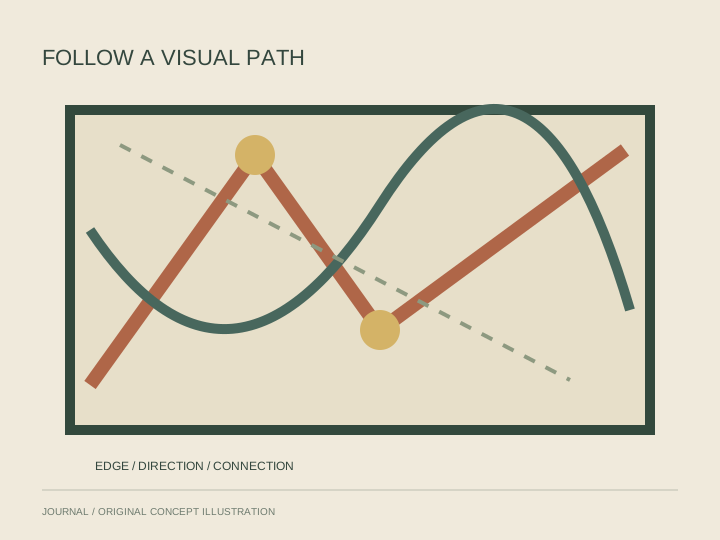
Before identifying a painting's subject, try noticing its directions. A roof edge, a bent arm or a sequence of upright trees can provide a route for your attention. You do not need to know the artist's biography to begin that observation.
Find an actual line
Start with a visible edge or drawn mark. Follow it slowly. Does it continue across the picture, stop against another form or change direction? Line can define a boundary, describe a shape or organize movement within an image.
Choose one passage and describe only what is present: straight, curved, broken, thick or thin. This keeps the first step grounded in the work rather than in a guessed intention.
Look for a suggested connection
Now search for a direction that is not drawn as one continuous mark. Several separate shapes may align, or a figure's gaze may encourage you to look toward another part of the scene. Compare that suggested route with the visible lines you found earlier.
Test your first impression
Sketch a tiny outline of the composition on scrap paper. Include only a few directions, leaving out the details of the subject. Then return to the original and see what your diagram missed.
The aim is not to prove that every diagonal has the same meaning. It is to explain how this arrangement works for you as a viewer. A useful account can stay modest: 'These repeated curves bring my attention back to the center,' supported by the specific curves you can point to.