A Painting Can Feel Balanced Without Being a Mirror Image
Compare the pull of different areas in a composition without expecting equal objects on both sides.
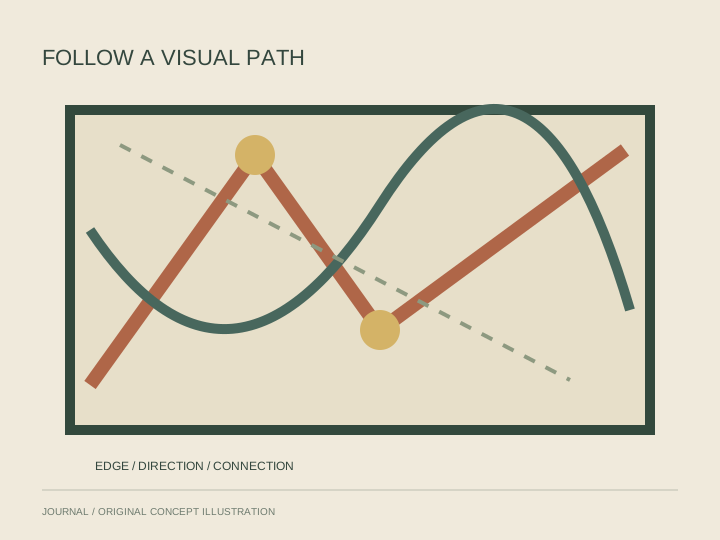
When we say a painting feels balanced, we may imagine matching objects arranged on either side of its center. Some compositions work that way. Others invite a much less literal comparison: a small dark area might hold attention beside a larger quiet one.
Begin with the whole arrangement
Visual balance concerns how weight seems distributed among a picture's elements. It does not require objects to have equal physical size. Look at the work as a whole before counting figures or measuring the distance between them.
Choose two broad areas of the picture. Describe what draws you toward each one. You might notice a strong edge, a dense group of marks, a change in color or an unusually open area. Treat these as observations to test, not a formula that assigns every feature a fixed score.
Compare two viewing passes
During the first pass, follow whatever catches your attention. During the second, deliberately start somewhere else. Does your gaze return to the same place? Does an initially quiet area become more noticeable once you have looked away from the strongest detail?
Write down the sequence rather than simply calling the picture balanced or unbalanced. A short account of how you looked can reveal more than a label. Another viewer may notice a different sequence without either person being wrong.
Ask what symmetry would change
Imagine the strongest feature repeated on the opposite side. You do not need to edit or reproduce the work; just consider the possibility. Would the repeated feature make the image feel steadier, more repetitive or less surprising to you?
Return to what is actually present. The imagined alternative helps name a choice in the existing arrangement, but it is not evidence of an abandoned design or an artist's intention. Keep that boundary clear in discussion.
End with a sentence that identifies two features and describes their relationship. That gives your interpretation something visible to rest on. Balance becomes a way of examining a picture rather than a rule that every painting must obey.