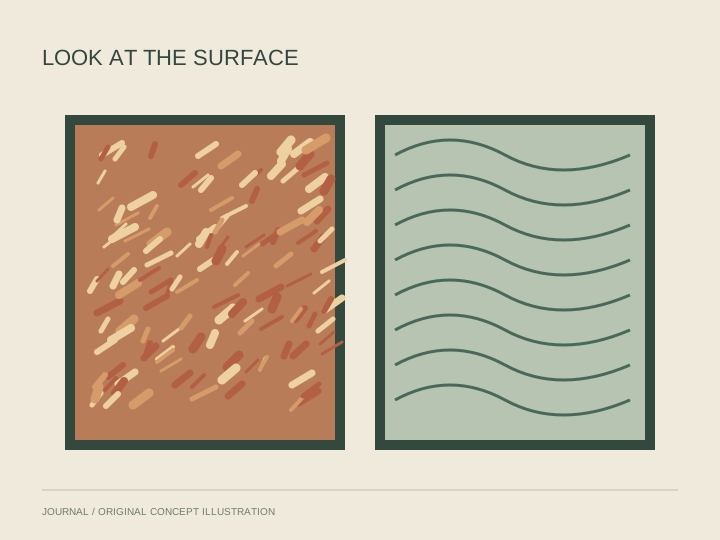
Look for a Connection Between Distant Parts of a Picture
Test a claim of visual unity by tracing a relationship between two areas that are far apart.
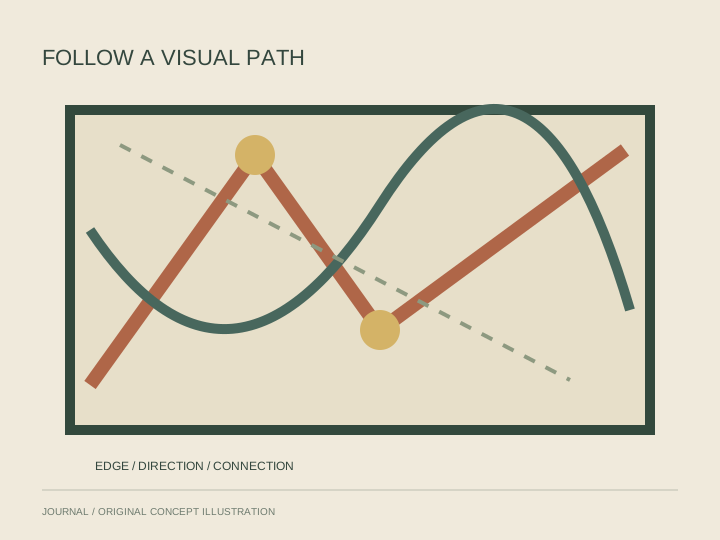
A picture may feel connected even when it contains many different subjects. Getty uses unity to describe the sense that the parts belong together. To explore that idea, choose two distant areas and ask what visible relationship might connect them.
Avoid starting with the whole picture
On a separate sheet, identify an area near one side and another near the opposite side. Describe each briefly. The descriptions should be specific enough that another viewer can find both areas without needing your finger as a guide.
Choose a single relationship to investigate: a similar direction, a recurring contour or a color that appears in both places. There is no need to prove every possible connection at once.
Trace the relationship
Look for an intermediate detail that carries the relationship across the picture. Draw a simple route on your notes, using words when a sketch would be unclear. If the route involves a leap, mark the gap rather than pretending there is an unbroken chain.
Then find a difference between the two selected areas. A connected composition does not require all its parts to look identical. Your description becomes more useful when it can accommodate both the relationship and the difference.
Reassess the first impression
Return to the overall view. Does the specific connection help explain why the picture feels cohesive, or did your first impression lead you to overstate a weak resemblance? Either answer is worth recording.
Keep the result as a supported proposal about the visible arrangement. It does not establish how the work was planned, how long it took or what the artist meant to communicate.
The cover is an original diagrammatic illustration, not a reproduction of a named artwork.