When Many Small Lines Begin to Look Like Form
Look at the spacing and direction of drawing marks before treating a shaded area as a single patch of tone.
From a distance, a shaded passage in a drawing may appear to be one continuous area. A closer view can reveal many separate marks. Looking at those marks changes the question from what object is pictured to how the picture has been built.
Find a passage you can inspect
Hatching uses groups of lines to suggest tone or form. Parallel lines, crossing sets of lines and marks that curve around a shape offer different ways to build a passage. Begin with a reproduction detailed enough to show individual marks.
If the image is too small, do not enlarge it until the pixels become a substitute for evidence. Record that the marks cannot be resolved at this scale and choose a clearer published detail for the exercise.
Describe three relationships
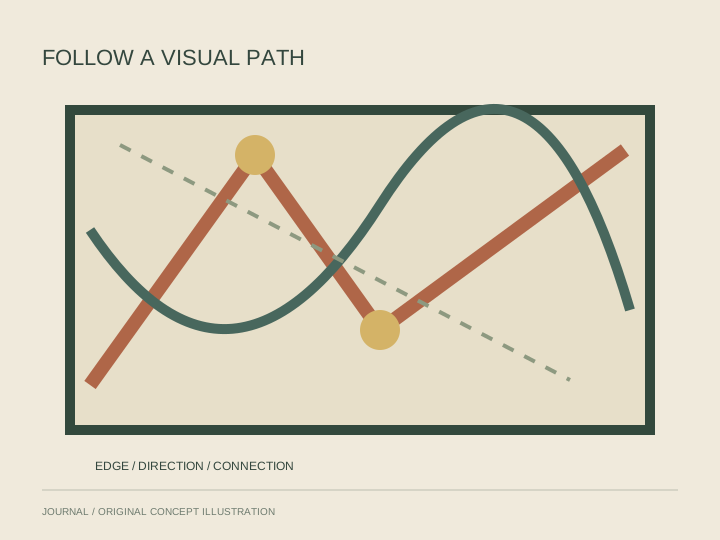
First compare the distance between neighboring lines. Next look at their direction. Finally, notice whether the marks stay similar or change as they move across the form. Use plain descriptions before naming a technique.
You might write that several lines bend in the same direction or that one passage contains more closely spaced marks than another. Those observations are useful even when you cannot identify the drawing medium from a screen.
Step back to the whole
Return to the complete image. How do the small marks contribute to the larger form you noticed first? Describe a connection between one local passage and the whole without assuming that every line has a separate symbolic meaning.
If you try a drawing exercise on your own paper, make two small patches with different spacing and compare them. That is a way to explore your own mark-making, not a reconstruction of the artist's working process.
End with a question you would like to examine in the original drawing. A detailed reproduction can support looking, while leaving the actual surface, scale and materials partly unknown. The cover is an original illustration about lines rather than a reproduction of an exhibited drawing.