Follow What Happens at a Picture Boundary
A form that stops at the frame and one that seems to continue beyond it can invite different kinds of attention.
The center of an image often receives the first look. Its boundary deserves a separate one. An object can be fully enclosed by the picture, partly cut off or positioned so that your imagination supplies a continuation beyond the visible area.
Walk around the perimeter
Start at one corner of a complete reproduction and follow its four sides with your eyes. Note the forms that meet the boundary. Do not begin by deciding whether the crop is good or bad; simply record what is present.
Check that the image actually shows the whole artwork. A photograph of a detail can create a boundary belonging to the reproduction rather than the original composition. If the image's scope is unclear, treat that as a limit on the exercise.
Describe one interruption
Choose a form that meets an edge. Explain how much is visible and what you find yourself imagining beyond it. Keep that imagined continuation separate from your description of the actual image.
Next choose a form that is surrounded by visible space. Compare the two placements. Does one feel more contained or more connected to a space outside the picture? Phrase the result as your response, supported by those placements.
Return to the whole image
Look at how the perimeter relates to the main arrangement. A boundary observation may change your sense of where the picture's activity begins or ends, or it may remain a quiet secondary feature. Either result is useful.
Avoid converting the exercise into a story about an artist's intentions without evidence. You can identify a visible choice and describe its effect on your looking while leaving the making process open.
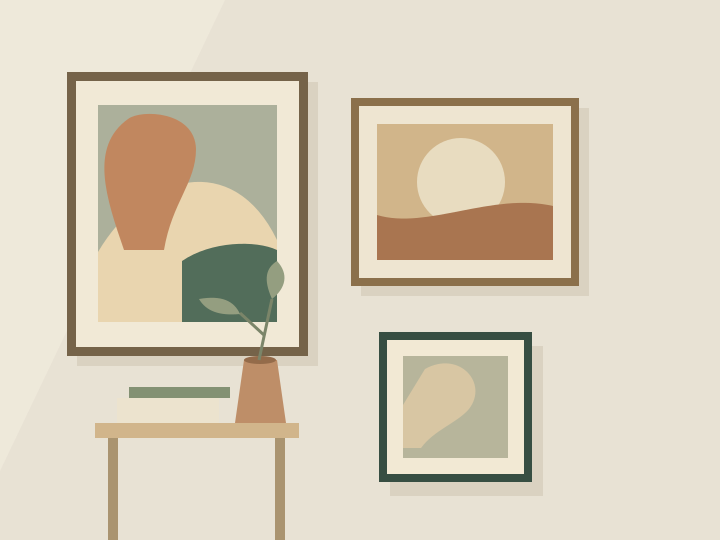
Finish with one sentence about the center and one about the perimeter. Together they may provide a more complete account than a description of the recognizable subject alone. The framed-art illustration is a general visual prompt, not a reproduction of the work you choose to examine.