Use Overlap to Describe Layers in a Picture
Start with visible boundaries when describing depth, and keep an imagined scene separate from what the picture actually shows.
A picture can suggest a space that seems to continue behind its visible forms. Before explaining the whole scene, look for one place where a form interrupts another. That boundary offers a small, concrete starting point for discussing layers.
Locate the interruption
Choose two forms whose outlines meet. Describe which boundary remains visible and which seems to stop. Avoid naming a complete three-dimensional arrangement before you have recorded that relationship.
Space is an element of art, and looking at relationships between forms helps make a discussion of it specific. The initial observation can be simple: one shape partly covers another in the image.
Offer a reading, then test it
Explain which form seems nearer to you and identify the visible feature supporting that impression. Treat the result as a reading of the picture rather than a measurement of an actual distance.
Look elsewhere for another boundary. Does it support the same sense of depth, complicate it or leave the arrangement uncertain? A picture need not behave like a straightforward photograph to reward close attention.
Leave hidden areas undescribed
If you imagine what continues behind an overlapping form, mark that as an imagined continuation. Do not add unseen architectural details or assume that a depicted object has a particular construction merely because its visible part looks familiar.
Write a short account with two parts: the boundary you observed and the spatial relationship it suggested. Separating those parts makes it easier to compare your account with another viewer's without treating disagreement as a failure.
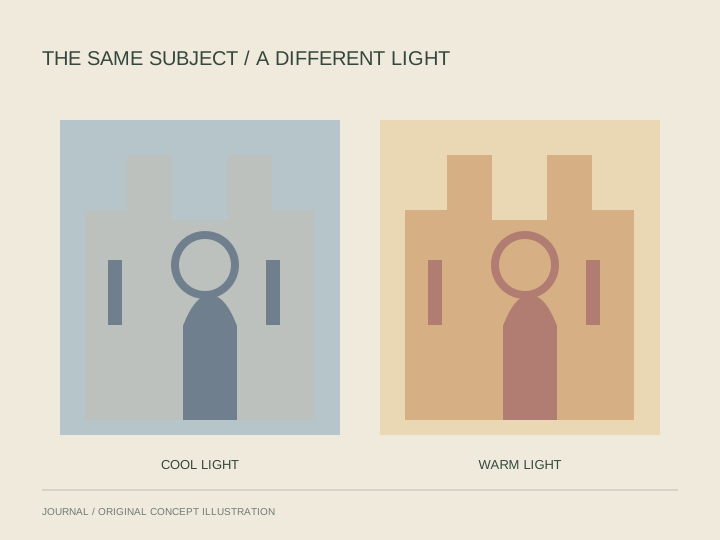
Return to the complete work at the end. A local overlap may contribute to a larger sense of distance, or it may sit within an intentionally ambiguous space. The original architectural-light illustration accompanying this article is a general prompt for looking, not documentation of a real building or an artist's perspective system.